← Main page · Glossary · Words & phrases · Practice · Four languages · Resources · Feedback
How the Language Works
A plain guide to writing and saying Reo Māori Kūki ʻĀirani, and to how sentences are put together. You do not need to know any grammar words to use it — read a section, look at the example, and try it.
I make no claim to this knowledge — it belongs to the people who recorded it, and I am grateful for their work. Each section links to the source it draws on, and they are all gathered at the foot of the page under where this comes from, so you are welcome to go and read them in full.
On this page
- The Cook Island Maori Alphabet - Ara Reta
- The Hamsah - 'Āmata
- The Macron - Mākarona
- Nouns - Au Nomena
- Words for people - Piri Nomena
- Describing words
- Comparing things
- Doing words - Au Verepa
- Verbs with and without an object
- Who did it, or what it happened to
- When, how and where
- Joining words
- Saying “who” and “that”
- Small linking words
- Greetings and exclamations
- Two kinds of belonging
- Repeating what someone said
- How a sentence is ordered
- Saying no
- Phrases and clauses
- Punctuation
- Where this comes from
Writing and sound
The 13 letters
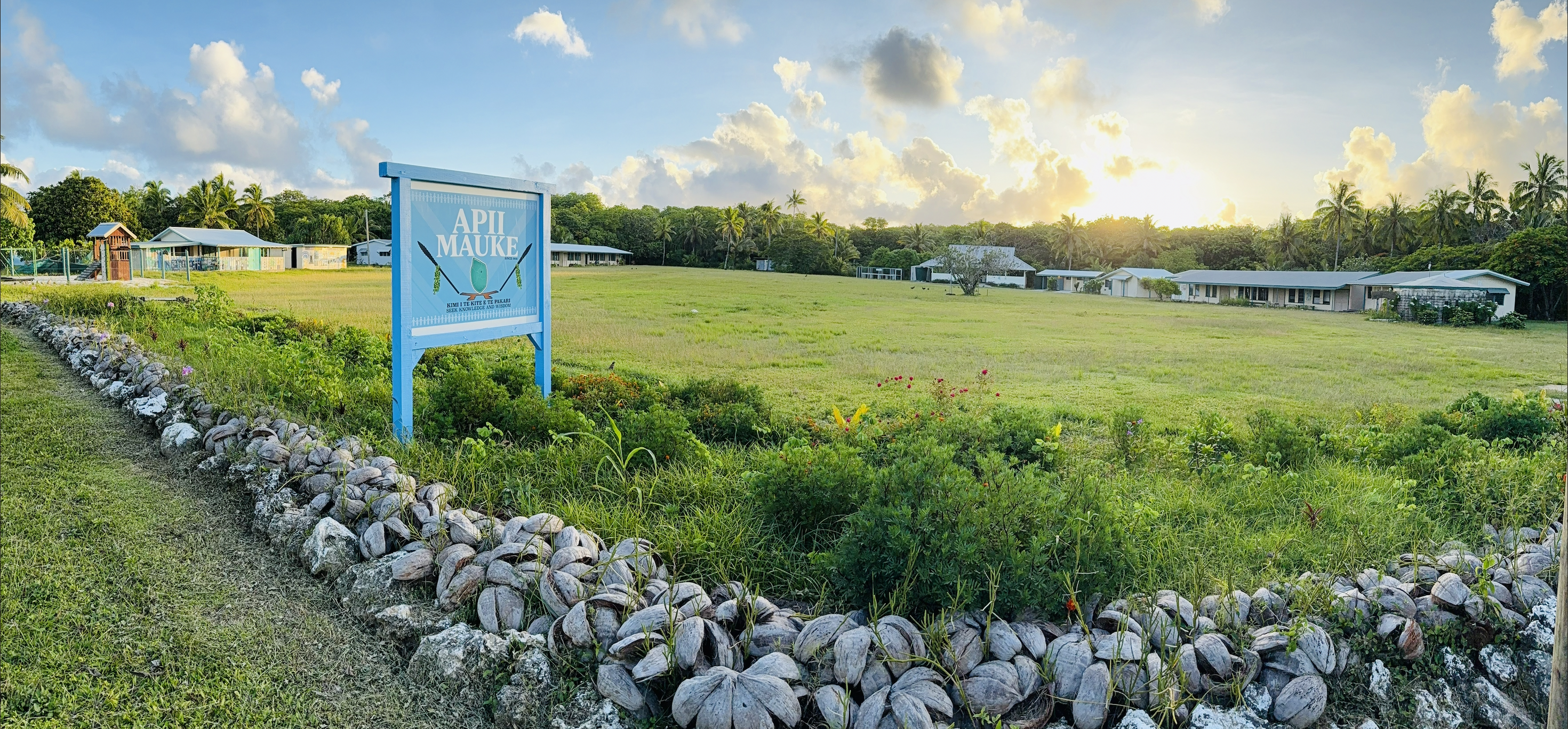
The alphabet has 13 letters: a, e, ng, i, k, m, n, o, p, r, t, u, v. Ng counts as one letter and makes one sound — the sound at the end of the English word sing. Every sound on the school sign at the top of this page is made from those thirteen, and the motto beneath it reads Kimi i te kite ē te pakari — seek knowledge and wisdom.
vai = water
tāne = man / husband
ngūtupa = door
Read more: Orthography Guidelines, section 2 — the alphabet, vowels and consonants (PDF)
The ʻāmata
The ʻāmata is the small mark that looks like an apostrophe: ʻ. Some people call it a hamzah or a glottal stop. It is a tiny catch in the throat, and it is a real part of the word — leaving it out can change the meaning or make the word hard to recognise.
taʻi = one
Say it as two beats, ta-i, not like the English word “tie”.
The macron
A macron is the bar written over a vowel: ā, ē, ī, ō, ū. It means you hold the vowel longer. The length is part of the word, so a missing macron can turn one word into another.
kopa = a dent · kōpā = narrow
marama = moon · mārama = daylight, or understanding
Read more: Orthography Guidelines — why long and short vowels change the meaning (PDF). To check how any word is spelled, including its macrons and ʻāmata, use the Dictionary of Cook Islands Languages — the Ministry recommends it as the first place to look.

Words and what they do
Naming words
Naming words (nomena) name a person, a place, a thing or an idea. They usually follow te (“the”), or te au when there is more than one.
te tamaiti = the child
te puka = the book
te vai = the water
Words for people
These words (piri nomena) stand in place of a name. Two things make them different from English. There is a separate form for exactly two people, and when you say “we” you choose whether the person you are talking to is included or not.
| Word | Means |
|---|---|
| au | I, me |
| koe | you (one person) |
| ʻaia | he, she |
| tāua | we two — you and I |
| māua | we two — but not you |
| tātou | we all — you included |
| mātou | we all — but not you |
Kua kai au i te ika. = I ate the fish.
Kua kai tāua i te ika. = You and I ate the fish.
Read more: Grammaire du maori des îles Cook — the fullest free list of the pronouns, with several examples for each. It is written in French; your browser will translate it.
Describing words
Describing words (ʻakataka nomena) tell you more about a naming word. They usually come after the word they describe, which is the opposite of English.
te tangata mānea = the beautiful person
te puka rikiriki = the small book
Mānea is the Rarotongan word for beautiful. Other islands have their own.
Comparing things
There is no ending like the English -er and -est. Instead you lean on the situation, repeat a word, or add an ending that strengthens it. -ngū is one of those.
kava = bitter
kavangū = very bitter
Read more: Orthography Guidelines, section 3 — the list of prefixes and suffixes and what each one does (PDF)
Doing words
Doing words (verepa) are actions, events or states. They usually come near the start of a sentence, with a small word in front that tells you when it happened: kua for something finished, and ka for something still to come.
Kua kai au i te ika. = I ate the fish.
Āpōpō ka aere au. = Tomorrow I will go.
Verbs with and without an object
Some doing words need something for the action to land on. Others stand on their own. The same word can go either way depending on what you are saying.
Kua kai au i te ika. = I ate the fish. — the fish is what was eaten.
Kua aere au. = I went. — nothing else needed.
Who did it, or what it happened to
You can put the doer first, or you can put the thing it happened to first. The second way often adds an ending such as -ia or -ngia.
Kua raveia te uipāʻanga i nanai. = The meeting was done yesterday.
kata = laugh → katangia = be laughed at
Read more: Orthography Guidelines, section 3 (PDF) — it also explains when -ia is written as a separate word, which is what happens in the example above.
When, how and where
These words (piri verepa) add the time, the manner, the place, or how much.
Kua raveia te uipāʻanga i nanai. = The meeting was done yesterday. — nanai = yesterday.
Kua rave poitirere ia te uipāʻanga. = The meeting was surprisingly done. — poitirere = surprisingly.
Joining words
Joining words (kupu paʻupaʻu) tie two parts of a sentence together. They are very useful when one thing has happened and another is still to come.
Kua kai au, ē ka inu au. = I ate, and I will drink.
Saying “who” and “that”
There is no single word for the English who, which or that. You say the naming word, then simply carry on and describe it.
Ko koe ʻoki, te tangata tā te ʻakavā e kimi nei. = You are the person whom the police are looking for.
Small linking words
Small linking words (perepetītīo) show where something is, where it is going, or where it came from. Two common ones are i (at, in, on) and ki (to).
I toku aereʻanga ki Avarua nanai = On my way to Avarua yesterday
Greetings and exclamations
Short words said on their own, to greet someone, to react, or to get attention.
Kia orāna! = Hello. Literally, may you live long.
Meitaki! = Thank you. Also: good.
Belonging, and repeating what was said
Two kinds of belonging
A and o both show that something belongs to someone, and English has no equivalent. Roughly: a is used when the person has charge of the thing or chose it, and o when they did not — parts of the body, family, where you are from, things that are simply so.
The safest way to learn these is not by rule but by pair: remember the word and its possessive together, the way you learn any other word.
Te moa a Moana = Moanaʻs chicken — a
Te rima o Mere = Mereʻs hand — o
tōku mimiti = my forehead — o
Read more: Grammaire du maori des îles Cook sets out which things take ā and which take ō, with a long list of examples.
Repeating what someone said
You can give the exact words, or you can report what was meant. Kī means say or tell.
Exact words: Kua kī a Mere, “Ka aere au.” = Mere said, “I will go.”
Reported: Kua kī a Mere ē ka aere ʻaia. = Mere said that she would go.
Everyday speech varies, so treat these as good models rather than fixed rules.
How sentences are built
How a sentence is ordered
English usually starts with who did something. Reo Māori Kūki ʻĀirani usually starts with what happened, and the person comes after. This is the single biggest difference to get used to.
Kua kai au i te ika.
Word for word: ate — I — the fish. In natural English: I ate the fish.
Saying no
A positive sentence says something is so. A negative sentence says it is not. Kāre is the common word for no or not.
Kei konei ʻaia. = He is here.
Kāre ʻaia i konei. = He is not here.
Read more: Grammaire du maori des îles Cook covers kāre and kore, and the small words (kua, ka, tē…nei, kia, ʻauraka) that set the time and the mood of a sentence.
Phrases and clauses
A phrase is a handful of words that work together but do not say that anything happened. A clause does say something happened. Put them together and you have a longer sentence.
Phrase: te puka rikiriki = the small book
Clause: Kua aere au = I went
Together: Kua aere au ki te ʻare. = I went to the house.
Two names worth knowing: the subject is who or what is involved, and the predicate is what is said about them. In this language the predicate usually comes first.
Kua kai au i te ika.
Predicate: Kua kai i te ika = ate the fish. · Subject: au = I.
Punctuation
Punctuation works as it does in English: a full stop ends a statement, a question mark ends a question, commas separate ideas, and names begin with a capital letter. Spell macrons and the ʻāmata consistently — they belong to the word.
Ko Mere tēia. = This is Mere.
ʻEaʻa koe i aere mai ei? = Why did you come?
Quotation marks show someoneʻs exact words. They are a modern way of writing rather than anything from spoken language. Keep the macrons and the ʻāmata inside the quotation exactly as they belong.
Kua kī te puaʻapiʻi, “ʻAere mai!” = The teacher said, “Come here!”
Where this comes from
Everything on this page already existed, free and open to anyone. The trouble is that it is scattered — a government PDF here, a university dictionary there, a school vocabulary list, a grammar written in French. None of it sits behind a paywall. Almost none of it is where a learner would think to look.
So I have read across all of it, set the same ideas out in one order and in plain English, and named every source. Nothing here replaces the originals. This page is simply a door to them: one place where a learner can start, and every link below opens the material it came from, in full, at no cost.
The main source for this page: the alphabet, vowels and consonants, prefixes and suffixes, capital letters, the days and the months, and a table of vocabulary differences between the islands including Māʻuke. 2024.
The page the guidelines sit on, in case the link above ever moves. It also holds the guidelines for Niue, Tokelau, Sāmoa and Tonga.
Free online dictionaries for nine varieties. The Ministry names this as the first place to check how a word is spelled. There is a free phone app as well.
Words and expressions that come from Māʻuke itself. Its neighbours are there too — ʻĀtiu and Mitiʻaro.
Free vocabulary lists as spreadsheets, covering the words and the grammar students are expected to know: Level 1, Level 2, Level 3. Past exam papers are on the same page.
The fullest free grammar on the internet, and far longer than this page: pronouns, the small words that set time and mood, question words, ā and ō belonging, and a word list. Your browser will translate it into English.
Two books stand behind nearly all of the above, if you want the real thing: the Cook Islands Māori Dictionary (Buse, Taringa, Biggs & Moekaʻa, 1995) — the most authoritative work on the language — and Ko te Karāma o te Reo Māori o te Pae Tonga o Te Kuki Airani: A Grammar of Southern Cook Islands Māori (Nicholas, 2016).